
Lesson 4: The Second Crusade: When the Big Names Showed Up
(and It Still Fell Apart)

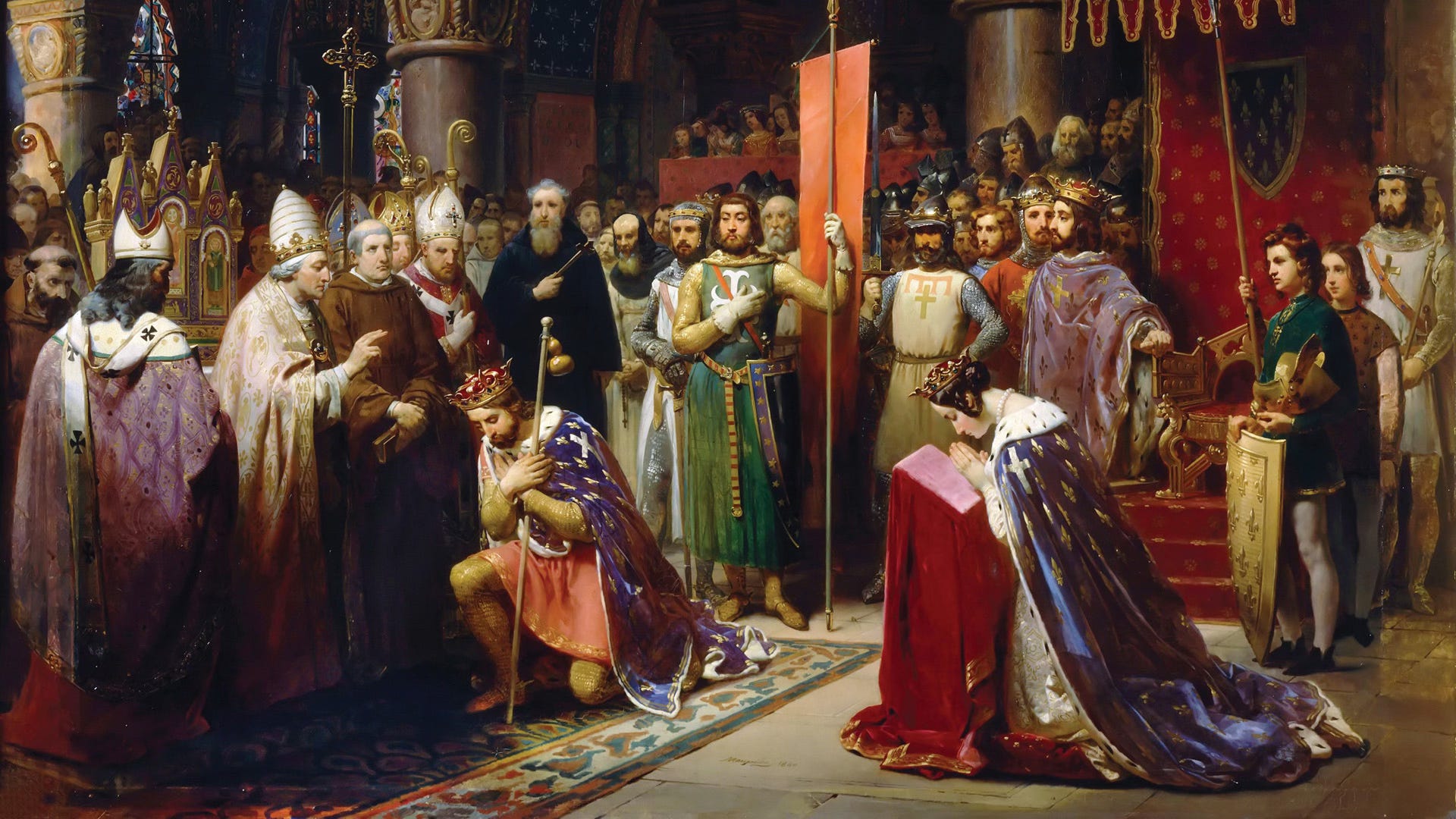
We started to jump into the Second Crusade and how the kings joined in; however, we have seen that with political power comes political problems. Couple that with the instability of the Middle East, and we have something dangerous brewing. By the time we get to the Second Crusade, the story feels like it should be simpler.
The First Crusade had “worked.” Jerusalem was in Latin hands. The Crusader States existed. Europe knew the route. The preaching machine was established. And now, after Edessa fell in 1144, the West had a clear reason to move again.
The Second Crusade runs roughly 1147–1149, and the headline leaders are exactly the kind of people you’d think would guarantee success: Conr. III (Conrad III of Germany) and Louis VII of France. The pope behind it is Eug. III, and the preacher who put gasoline on the call is Bern. of Clairvaux.
But almost immediately, the expedition begins to lose strength before it even reaches the Holy Land. Conrad’s army takes the classic land route through the Balkans and into Byz. territory, aiming to cross Anatolia as the First Crusade did. The problem is that Anatolia in the 1140s is not the same as in 1097. Supplies are harder to secure. Coordination is worse. And the Selj. know exactly how to punish a huge army stretched thin on hostile ground.
In October 1147, Conrad’s force was hammered near Dorylaeum (modern Eskişehir region). It’s a Seljuk victory, and it’s the kind of defeat that doesn’t just cost men, it costs momentum and confidence. The Germans limp back toward safer ground, and Conrad eventually goes part of the way by sea rather than trying to drag the remains of his army across the interior.
Louis’s army doesn’t get a clean run either. In January 1148, the French were hit hard at the Battle of Mount Cadmus in Anatolia (near Laodicea/Chonae). It’s another Selj. victory, with heavy losses, more chaos, and one more reminder that this crusade is being wrecked on the march.
So before the crusade even reaches the main target zone, a big part of its fighting strength is already gone. This is where the story turns from “bad luck” into “structural failure.”
Because when these battered armies finally reach the Levant, they don’t arrive with a single coherent plan. They arrive with bruised egos, competing leadership, and the usual crusader problem that never goes away: everyone agrees God wants victory, but no one agrees what victory should look like, and each man believes they are the “one” God chose to accomplish this victory.
By April 1148, Conrad reached Acre, and Louis came down from the north. A major council, often called the Council of Acre, is held, where the leaders debate what to do next. Edessa, the original reason for the crusade, is no longer realistic. The decision swings toward a new target: Damascus. And on paper, Damascus probably felt like a smart choice. It was close enough to matter, important enough to be worth it, and threatening enough that taking it would strengthen the Kingdom of Jerusalem. However, in reality, Damascus was the moment the Second Crusade broke out publicly.
The Siege of Damascus lasted only a few days, from 24 to 28 July 1148, and ended in a humiliating withdrawal. Not because the crusaders lacked courage, but because the campaign was poisoned by logistical problems, shifting plans, and leadership disputes over who would control the city if it fell. In a war in a location like this, plans, communication, and strategy are of paramount importance for a successful military campaign; however, in reflecting on the totality of circumstances, this was a doomed campaign.
And that failure mattered far beyond those four days. Britannica’s blunt summary is basically correct: Damascus ensured the crusader states would remain on the defensive, surrounded by increasingly capable enemies. Now, if you’ve heard someone say, “The Second Crusade was a total failure,” there’s one wrinkle you should know.
While the main Levant operation collapses, there are “side theater” crusade actions in 1147 that do succeed, especially in the West. One of the biggest is the Siege of Lisbon (1 July–25 Oct 1147), in which crusaders helped Portuguese forces capture Lisbon from the Almoravids. That’s a real victory and a major turning point for Portugal.
And in the north, you also have the Wendish Crusade (1147), a campaign directed against pagan Slavic groups along the Baltic frontier. So yes, the “Second Crusade” is bigger than just the march to Jerusalem. But if we’re speaking plainly, the crusade everyone means when they say “Second Crusade” was the kings’ Holy Land recovery effort, which ended in disappointment. That brings us back to the spiritual promises, because that’s where the emotional fallout hits.
Eug. III’s crusade call and Bernard’s preaching leaned on the same basic framework that propelled the First Crusade: taking the cross was presented as a spiritually serious act, tied to the church’s promised benefit for those who went in devotion. That framework works well when the story ends with Jerusalem. It works far less well when the story ends with a retreat from Damascus after four days.
And that tension between the preached certainty of divine favor and the lived reality of strategic failure is one reason the Second Crusade is so historically significant. It forces the medieval West to wrestle with a question it didn’t want to face: What do we do when the crusade is preached as holy, but the outcome is humiliating?